Poucas palavras:

Blog criado por Bruno Coriolano de Almeida Costa, professor de Língua Inglesa desde 2002. Esse espaço surgiu em 2007 com o objetivo de unir alguns estudiosos e professores desse idioma. Abordamos, de forma rápida e simples, vários aspectos da Língua Inglesa e suas culturas. Agradeço a sua visita.

"Se tivesse perguntado ao cliente o que ele queria, ele teria dito: 'Um cavalo mais rápido!"

Mostrando postagens com marcador blog. Mostrar todas as postagens

quinta-feira, 1 de agosto de 2013

SUGESTÃO DE ATIVIDADES PARA NÍVEIS INTERMEDIÁRIO E AVANÇADO DE INGLÊS.


Na verdade, esses vídeos não seriam atividades de longa duração, mas poderiam ser explorados pelo professor de diversas formas, desde perguntas mais especificas ou até mesmo como forma de “energizar” a turma. Pois é, existem aqueles momentos, principalmente em aulas de longa duração, em que os alunos ficam “alheios” e parecem perder o foco. Essa postagem surgiu primeiro na nossa página do Facebook (veja) para depois vim parar aqui no blog.


Se for utilizado como WARMER, o professor poderá fazer o mesmo papel do apresentador, Jimmy Kimmel, e pausar o vídeo sempre que achar necessário e pedir para que os estudantes, baseados na linguagem corporal dos entrevistados, adivinhem o que eles irão dizer. Aqui podemos trabalhar como um aquecimento para tópicos como futuro, passado simples, presente simples ou “present perfect”.


Tenho preferência pelos vídeos mais engraçados como:


Have You Ever Been Arrested? (Present perfect)


Have You Ever Smoked Pot? (Present perfect)


How Old Were You When You Lost Your Virginity? (Past Simple)


Are You Stupid? (present simple)


Claro que os vídeos não darão aula por você, professor, mas poderão te ajudar muito a tornar as mesmas mais engraçadas e fazer com que os alunos se sintam mais à vontade para falar em inglês (não seria esse um dos obstáculos que temos?). Só alerto aqui para o cuidado na hora de preparar a aula, pois não seria nada apropriado perguntar aos alunos, após ver os vídeos ou mesmo antes, coisas do tipo: How Old Were You When You Lost Your Virginity? Ou Are You Stupid?  Seria burrice e a aula teria efeito totalmente contrário. Podendo causar até o seu desligamento da escola ou perda de alunos. (Preciso dizer isso, pois acredito que alguns ainda pequem um pouco nesse quesito).


Como sabemos que temos todo tipo de aluno e existem aqueles que estão ali apenas porque foram obrigados, é sempre bom tomar cuidado no tipo de conteúdo, mesmo que todos nós saibamos que podem não ter como fins expor temas que são “tabus”, para evitar constrangimentos.


Lembrem-se que as aulas dependem muito da criatividade dos professores. Se gostou dessa postagem ou fizer uso da mesma, mesmo que com modificações e adaptações, compartilhe nos comentários.


Os vídeos foram postados nesse blog do site Youtube. Até essa data, 01 de agosto de 2013, todos estavam disponíveis no site. Não possuímos nenhum direito sobre os mesmo. Se o proprietário acreditar que os mesmos devem ser retirados do blog, faremos a remoção dos mesmos. 

segunda-feira, 1 de outubro de 2012

TODAS AS ENTREVISTAS DO BLOG: PRIMEIRA PARTE.


Nessa primeira parte das entrevistas, destacamos os professores de Língua Inglesa: Adir Ferreira, Sérgio Pantoja Junior, Danilo Pereira, Jobson Barbosa, Jean Carlos e André Riceliano.


Entrevista com o professor Adir Ferreira. O mesmo fala um pouco dos planos para o futuro profissional e divide conosco, um pouco da sua experiência de professor de Idiomas. >>LEIA A ENTREVISTA AQUI<<


Entrevista com o professor Sérgio Pantoja Junior. O mesmo fala das dificuldades da profissão, de quando decidiu se tornar professor de Língua Inglesa e faz uma breve avaliação do ensino de Língua Inglesa no Brasil. >>LEIA A ENTREVISTA AQUI<<


Entrevista com Danilo Pereira. O mesmo nos conta sua trajetória no ensino de língua inglesa. >>LEIA A ENTREVISTA AQUI<<


Entrevista com o professor de Língua Inglesa, Jobson Barbosa, professor na cidade de Mossoró-RN com bastante experiência na área de ensino de Língua Inglesa como Língua Estrangeria. >>LEIA A ENTREVISTA AQUI<<


Entrevista com o professor Jean Carlos. Aqui ele faz um resumo de sua vida profissional, traçando sua trajetória pelos caminhos do conhecimento ao idioma. >>LEIA A ENTREVISTA AQUI<<


Entrevista com o professor Inquieto pesquisador e professor de inglês e torcedor do Sport Recife. André Riceliano. O mesmo fala do interesse pela pesquisa, como começou o interesse pelo ensino/aprendizagem de idiomas e do projeto que criou: MISS- Método de Inglês Sem Stress.  >>LEIA A ENTREVISTA AQUI<<


Se você gostou dessas entrevistas, poderá gostar também da nossa série de reportagem sobre SOTAQUES NA LÍNGUA INGLESA. Para ser direcionado para a página contendo tal assunto, >> CLIQUE AQUI<<.


>>>CURTA A NOSSA PÁGINA NO FACEBOOK<<<


segunda-feira, 2 de julho de 2012

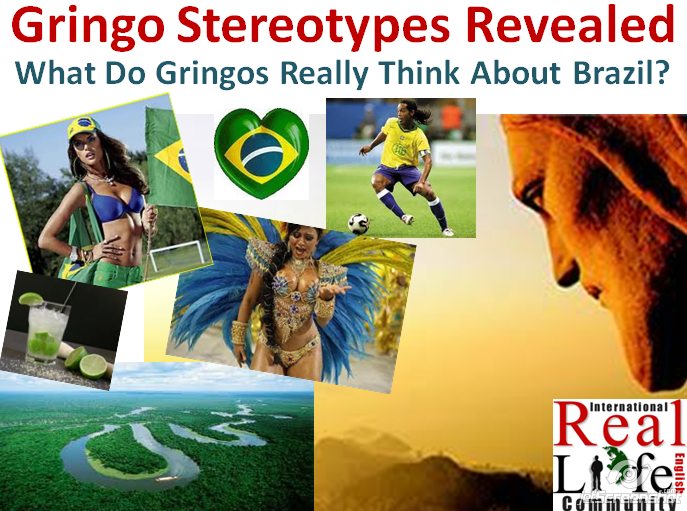
Gringo Stereotypes for Brazil: What Do We Really Think?


BRAZILIANS are INDIANS that live either in the AMAZON RAINFOREST (which really BELONGS TO THE U.S.A.) or on the beaches of RIO in either GRASS HUTS or FAVELAS. The only things they care about are CARNIVAL, SAMBA & FOOTBALL. Their WOMEN are all DARK-SKINNED, BEAUTIFUL, SEXY, EASY to get in bed, with BIG BUTTS and walk around NAKED in public. Brazilians eat FRUIT DIRECTLY FROM THE TREES, play SOCCER all day long on dirt fields while listening to SAMBA, drinking CAIPIRINHAS and playing with their PET MONKEYS. All Their politicians are CORRUPT, their streets are all DANGEROUS, their idols are PELÉ & RONALDINHO, and they speak SPANISH as their native tongue. And of course, BUENOS AIRES is the capital of Brazil.


How do you feel after reading all those stereotypes? Did you get mad? Take a deep breath and relax. This list of stereotypes did not come  from gringos.
This is actually a collection of negative stereotypes that Brazilians themselves reported when asked about what foreigner people think about Brazil.  The big question, why all the pessimism? Brazilians are one of the most loved peoples in the world. Show me the love!
Today I’m going to challenge you to take a hard look at your beliefs and ask you to reconsider some important questions that may drastically change the way you look at the Brazilian place in the world:
§  What does the world really think about Brazil?
§  What do Brazilians think the world thinks?
§  And finally, what do gringos really think?


WHAT BRAZILIANS THINK THE WORLD THINKS

A lot of Brazilians believe that the above list is an accurate representation of what the rest of the world really thinks about them.  Just to be clear, this is not what I think about Brazil. Frankly, I´ve never met anybody so ignorant or malicious to believe more than a few of them.
This is such a controversial topic, about which Brazilians love to talk, argue, vent and above all, exaggerate. It´s an extremely popular but delicate issue that has popped up again and again in the Real Life English International Community (a Belo Horizonte based social network, with 2,400 members, where gringos and Brazilians come together to share, discuss and learn English through culture, relationships  and media, on the internet and in Real Life Meetings).
Today I´m going to show both sides and try to suggest a more balanced truth as to what the rest of the world thinks.
TRY THIS PERSPECTIVE:

BRAZILIANS are the most FRIENDLY people in the world, forming a RICH & DIVERSE CULTURE that knows how to ENJOY life. The AMAZON RAIN FOREST is the LUNG OF THE WORLD, with huge BIODIVERSITY and FASCINATING indigenous HERITAGE that needs to be CELEBRATED and PROTECTED. The world knows Brazil for being the top FOOTBALL COUNTRY with HEROES like PELÉ & RONALDINHO that greatly INFLUENCED the history of soccer around the world.  Brazil knows how to PARTY and how to CELEBRATE its BEAUTIFUL CULTURE with many FESTIVITIES throughout the year such as CARNAVAL.  The WORLD IS AMAZED by cultural expressions like SAMBA and CAPOEIRA. RIO DE JANEIRO is one of the MOST BEAUTIFUL CITIES IN THE WORLD, with MARVELOUS BEACHES and everybody wants to visit CRISTO REDENTOR. Brazil is known for its INCREDIBLE MUSIC, DELICIOUS FOOD, including mouth-watering FRUITS, as well as world-renowned BARBECUES and FEIJOADA.  Brazilian WOMEN are known to be among the SWEETEST, MOST BEAUTIFUL & SENSUAL WOMEN in the world.


POSITIVE STEREOTYPES OF BRAZIL

This is a collection of the positive stereotypes about Brazil that many gringos, including myself, believe about Brazil and Brazilians. I grew up near Seattle, U.S.A. acquiring a lot these ideas long before I even stepped on Brazilian soil. Even though I had only met three or four Brazilians before my twentieth birthday, the vast majority of the things I had heard about Brazil were positive, and the Brazilians I met along the way only reinforced this positive viewpoint as pleasant people. And no, I was never taught that the Amazon Rain Forest belonged to the U.S. (nor had I ever heard of this happening until a few Brazilians vehemently told me that this happens in the U.S. Until now, this still seems absurd to me). Of course, even the positive side doesn’t represent an impartial perspective, as I was a dreamer with my eyes set on Brazil, but the positive stereotypes written here, in my opinion, reflect a much more accurate international perception of Brazil than the negative ones that a lot of Brazilians carry.
Honestly, I was always fascinated by Brazil. The two exchange students at my high school were really nice people and through the documentaries, movies, and other aspects communicated about Brazil through the American media, I became amazed by Rio, the Amazon Rain Forest, Samba and stories of Capoeira. I bought a poster of Cristo Redentor when I was in college and hung it on my wall as I dreamed of future adventures. Was my perception of Brazil totally accurate? NO! But it made sense to me and my upbringing, and it wasn´t negative.
My stereotypes were molded by Brazil’s international fame as put forth by the media that I was exposed to (largely about Carnaval, the Amazon Rain Forest, and Rio), and the handful of Brazilians I met. Not everything I believed was true. I was ignorant to a lot. For example, I remember being surprised when in college I met a blonde girl from the South of Brazil. That was embarrassing, but my mistake makes sense when you consider how Brazil was presented in the American media. I´m not excusing such glaring ignorance, but the media rarely showed blonde Brazilians, and in the United States we didn’t learn about European immigration in Southern Brazil or the ethnic makeup of Brazilians.
But, even with my ignorant points, I loved Brazilian culture, and I still do. Brazil is something I dreamed about for years and my perspective was built with the positive experiences that I searched for. I know that my perceptions are colored by my experiences and not by other peoples’, which is to say that reality is subjective. I represent the positive side of the spectrum, but in sober reflection, I know there is another side.
ONE GRINGO`S HUMBLE, BALANCED TRUTH

Brazil is another country with its own mix of positive and negative perspectives. In many ways, and for many people, Brazil is one of the brightest lights in the world, but for others, it’s just another third-world Latin American country with big problems. A lot of people love Brazil, with good reasons, because Brazilians are nice, charismatic and interesting, but others only see the problems: corruption, crime and inequality, among others.
There are a lot of misconceptions, but most of these don’t come from malice, but rather from ignorance, and the fact that people tend to generalize what they see in the mass media. Even if it´s difficult to accept, most Brazilians do the same thing with other countries. I’m American and most people, whether they see it or not, come at me with preconceptions that range from “America the glorious land of Hollywood, public order and happy people” to “America, the Great Satan that rapes and pillages the rest of the world to  drill for oil.” The truth is somewhere in the middle. The U.S. has a lot of serious problems with international relations, but there’s a lot of really awesome stuff about my country and people too. Not to recognize this is a mistake.
With Brazil, some of the most interesting aspects in the eyes of the rest of the world really are the Amazon Rain Forest, Rio de Janeiro, and Soccer. You guys are only one of the best soccer countries in the world. Even if you don´t play soccer, or dance samba, you don´t have to be offended if people think you do. It is not a bad thing. Brazilians should embrace this ignorance (or learning process) with patience for the rest of the world, and recognize that sometimes people haven’t been privileged to have the opportunity to learn about other aspects of Brazil, and that maybe these stereotypes represent interest in you and your culture rather than apathy. This represents your opportunity to be an ambassador for your country and culture and unveil the countless other amazing and interesting aspects of Brazil and Brazilians.


quinta-feira, 28 de junho de 2012

Learning English from Cartoons: The Queen's Historic Handshake.


This cartoon by Andy Davey from The Sun relates to the historic handshake between the Queen and the former IRA commander, Sinn Féin's Martin McGuinness, now Northern Ireland's deputy first minister, in Belfast on Wednesday. The Daily Telegraph puts the handshake into context:

The Queen, once a prime target for the IRA, shook hands not once but twice with Martin McGuinness, a former commander of the terrorist group, in a gesture that meant every bit as much as the sovereign’s historic visit to Ireland last year.
Barely a decade ago, the idea of the monarch, the ultimate symbol of British rule in Ulster, even being in the same room as Mr McGuinness, arguably the most recognisable former member of the IRA, would have been unthinkable. Full story >>

THE CARTOON

In the cartoon, we see the Queen reaching out to shake McGuinness's hand over the bombed-out wreck of a car—a clear reference to The Troubles, in which IRA terrorist attacks claimed the lives of hundreds of victims. Note the 'History' numberplate on the car, another reminder of past events.
VOCABULARY

You shake hands with someone or give someone a handshake.

From: theenglishblog.

quarta-feira, 1 de fevereiro de 2012

UMA SUGESTÃO DO BLOG: MOCHILEIRO-DAS-GALAXIAS.

Indico esse blog para aqueles que gostam de textos para reflexão, poesias, dicas de viagens, histórias, crônicas, contos e muito mais. Como nosso blog ainda encontra-se voltando das tão merecidas férias, indicamos mais leituras para nossos leitores.


Para acessar o blog clique em MOCHILEIROS-DAS-GALAXIAS.

sexta-feira, 2 de dezembro de 2011

PORTAL DA LÍNGUA INGLESA FOI SUGESTÃO DO BLOG "WALK & TALK" NO FACEBOOK.


Acabei de receber um e-mail dizendo que o blog PORTAL DA LÍNGUA INGLESA tinha sido indicado no Facebook (ver imagem acima). Fiquei muito feliz, pois se trata de um site sério e muito visitado (Walk & Talk).

Fico muito grato, pois a visibilidade do nosso blog está ficando cada vez maior. Não tenho Facebook, por isso não pude responder e agradecer pela indicação naquela rede social, mas daqui do blog, segue meu MUITO OBRIGADO pela força. Estamos quase chagando aos 500 acessos diários, nosso próximo objetivo.


Queremos melhorar e servir aqueles que querem aprender e/ou melhorar suas habilidades linguísticas na Língua Inglesa. E eles do (Walk & Talk) ainda sugeriram uma matéria sobre GLOBISH. Vou postar um texto sobre o assunto no futuro, diga-se de passagem, um dos meus assuntos preferidos. 


ler no blog "walk & Talk" http://walkandtalkbrasil.blogspot.com/2010/12/globish-por-luah-galvao.html

domingo, 27 de novembro de 2011

[IDIOMS] Você sabe o que “on top of the world” significa em inglês?


Successful Business Man Sitting on Top of The World Clipart 
| #14972 by DJArt
ON TOP OF THE WORLD é uma expressão idiomática americana. O significado da mesma é “to be feeling very happy”, ou seja, “feliz da vida”.


FAZENDO USO DA EXPLICAÇÃO DO WIKIPÉDIA:

Uma expressão idiomática ou expressão popular é um conjunto de palavras que se caracteriza por não ser possível identificar seu significado mediante o sentido literal dos termos analisados individualmente. Desta forma, em geral, é muito difícil ou mesmo impossível traduzi-la para outras línguas, principalmente as menos semelhantes. Leia mais>>

Na língua inglesa, o termo IDIOM corresponde ao conceito de "expressão idiomática" em português.


EM CONTEXTO:

Brad bought a new house and he feels on top of the world.

Brad comprou uma casa nova e está se sentindo feliz da vida.

John loves Yoko and it is making him feel on top of the world.

João ama Yoko e isso está fazendo ele se sentir feliz da vida.

EXISTE OUTRA FORMA DE DIZER “FELIZ DA VIDA” EM INGLÊS:


Brad bought a new house and he is walking on air.

Brad comprou uma casa nova e está se sentindo feliz da vida.

John loves Yoko and it is making him feel like walking on air.

João ama Yoko e isso está fazendo ele se sentir feliz da vida.


Todos já devem ter percebido que “walk on air” também significa “feliz da vida”.

SE GOSTOU DESSA POSTAGEM, ESPERE QUE AINDA TEREMOS MAIS PELA FRENTE. NESSA SEMANA, POSTAREMOS MAIS ENTREVISTA. AGUARDEM. 

sexta-feira, 11 de novembro de 2011

Você sabe o que sabe o que quer dizer “He’s full of shit” em português?


Atenção: essa postagem exige um pouco de conhecimento (vocabulário) em inglês, pois a conversação não será traduzida. Procuramos mostrar o significado aos poucos tentando fazer com que você, leitor, tente criar suas próprias hipóteses.


Todo cuidado é pouco na hora de traduzir, se for o caso, ou de interpretar expressões como essa. Por quê? Porque sempre precisamos colocar os termos em contexto.

Sabemos que he = ele; is = é ou está; full = cheio; of = de; shit = bosta.
Você deve está pesando que o cara esteja cheio de bosta, não é?

Nada disso. Nem a tradução é: “ele está cagado”.

VEJAMOS A SEGUINTE SITUAÇÃO:

John: what are you doing, Mary?

Mary: what do you mean?

John: you told me you were sick. And now I find you here on the beach?

Peter: I told you not to trust this woman, John. She’s full of shit. She never tells the truth.

Já deu para pegar o significado? Não é difícil deduzir que a frase “She’s full of shit” pode ser tranquilamente trocada por “she is a liar”.
Agora ficou mais fácil ainda.


EM PORTUGUÊS:

Ok. Expliquei, expliquei, expliquei, mas teve alguém que não entendeu? Sem problema. Lá vai na língua de José Saramago:

He’s full of shit quer dizer Ele é um mentiroso.

Se você gostou desse tópico, acredito que vai gostar de outros relacionados aqui embaixo. O(A) amigo(a) saberia dizer como se diz “cagar” em inglês? (link).